
Pytorch 高级api实现Linear Model
Pytorch Fashion
- **Prepare dataset
- **Design moel using Class
- **Construst loss and optimizer(using Pytorch Api)
- **Training cycle (forward,backward,update)
forward for loss,backward for gradient and update
InPytorch,the compuattional graph is in mini-batch fashion,so X and Y are 3*1 Tensors
广播机制
import torch

x_data=torch.Tensor([1.0],[2.0],[3.0])
y_data=torch.Tensor([2.0],[4.0].[6.0])- Design Model 自动构造计算图
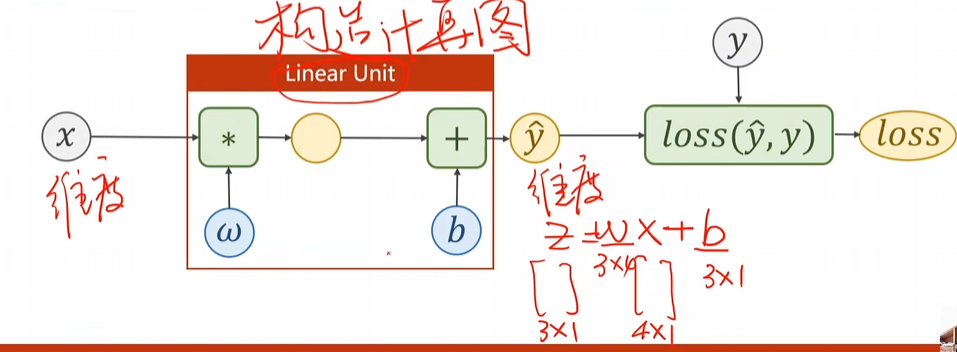
我们需要x和y的维度
class LinearModel(torch.nn.Module):
	#Member methods __init() and forward() have to be implemented
	def __init__(self):
		super(LinearModule,self).__init__()
		#Class nn.Linear contain two members Tensors:weight and bias
		self.linear=torch.nn.Linear(1,1)

	def forward(self,x):
		y_pred=self.linear(x)
		return y_pred
model=LinearModuel

criterion= = torch.nn.MSELoss(size_average=Flase)
#size_average=True 1/N*MSELoss
#优化器对象
optimizer=torch.optim.SGD(model,parameters(),lr=0.01)
**Our model class should be inherit from nn.Module,which is Base class for all neural network modules. Q:为什么没有backward: Pytorch中的Module会自动完成backward的操作 Q:什么是super(): nn(neturalnetwork).Linaer
**MSEloss()—>
这里的loss是一个标量 要是一个向量的话没有办法 backward
class Foobar:
	def __call__(self,*args,**kwargs)
		pass
**Q:*args?
**Class mm.Linear has implemented the magic method __call(),which enable the class can be called like a function.Normally the foeward() will be called
for epoch in range(100):
	y_pred=model(x_data)
	loss=criterion(y_pred,y_data)
	print(epoch,loss)

	#The grad computed by .backward() will be accumulated.So before backward,remember set the grad to Zero.
	optimizer.zero_grad()
	#Backward
	loss.backward()
	#Update
	optimizer.step()

#Output weight and bias
print('w= ',model.linear.weight.item())
print('b= ',model.linear.bias.item())
#Test Model
x_test=torch.Tensor([4.0])
y_test=model(x_test)
print('y_pred =',y_test.data)
**Training data 会随着训练指数减少 Test data 会随着epoch增加先减少后增加
**训练过程总计为三部分: 前馈 反馈 更新 forward backward update
Practice:Try Different Optimizer in Linear Regression
torch.optim.Adagrad
torch.optim.Adam
torch.optim.Adamax
torch.optim.ASGD
torch.optim.LBFGS
torch.optim.RMSprop
torch.optim.Rprop
torch.optim.SGD