
多分类问题处理
**Revision:MNIST Dataset: There are 10 labels in MNIST dataset.
Design 10 outputs using Sigmoid?
我们希望得到我们的样本的输出的概率分布 所以我们希望每一个都>0且 We hope the outputs is competitive! Actually we hope the netural network outputs a distribution
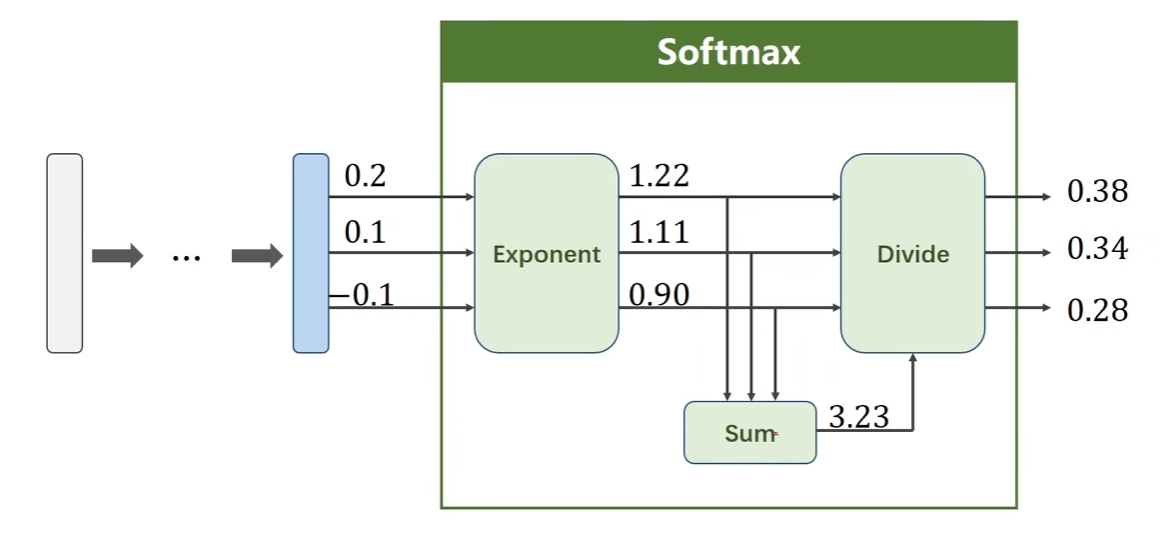
Output a Distribution of prediction with Softmax
**Softmax layer: such that:
Softmax Layer:
Suppose is the output of the last inear layer,the Softmax function:
**分母求和保证结果为1
Softmax Layer -Example
Loss function-Cross Entropy
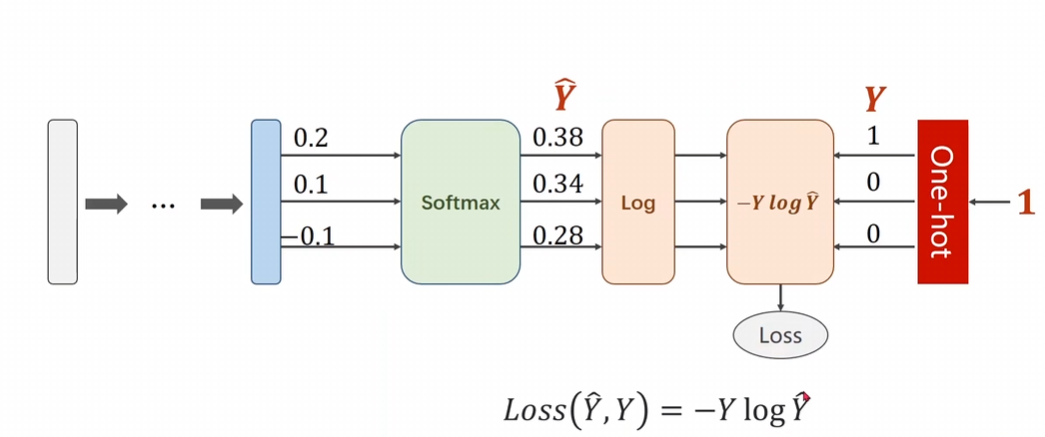
将softmax的输出转化为独热编码one-hot code形式
#NLLloss
import numpy as np
y=np.array([1,0,0])
z=np.array([0.2,0.1,-0.1])
y_pred=np.exp(z)/np.exp(z).sum()
loss=(-y*np.log(y_pred).sum())
print(loss)
import torch
y=torch.LongTensor([0])
z=torch.Tensor([0.2,0.1,-0.1])
#torch提供了crossEntropyLoss的交叉熵损失函数
criterion=torch.nn.CrossEntropyLoss()
loss=criteration(z,y)
print(loss)**Mini-Batch:batch_size=3
import torch
criterion=torch.nn.CrossEntropyLoss()
Y=torch.LongTensor([2,0,1])
Y_pred1=torch.Tensor([0.1,0.2,0.9],
					 [1.1,0.1,0.2],
					 [0.2,2.1,0.1])
Y_pred2=torch.Tensor([0.8,0.2,0.3],
					 [0.2,0.3,0.5].
					 [0.2,0.2,0.5])
l1=criterion(Y_pred1,Y)
l2=criterion(Y_pred2,Y)
print("Batch Loss1= ",l1.data,"\nBatch Loss2=",l2.data)
**Exercise:CrossEntropyLoss Vs NLLLoss
- What’s the differences?
- Reading the document:
- Try to know why:
- CrossEntropyLoss<==>LogSoftmax+NLLLoss
Back to MNIST Dataset:
Implementation of classifier to MNIST dataset:
- Prepare dataset
- Design model using Class
- Construct loss and optimizer
- Traing cycle+Test
#For constructing DataLoader
import torch
from torchvision import transforms
from torchvision import datasets
from torch.utils.data import DataLoader
#For using Relu()
import torch.nn.functional as F
import torch.optim as optim
batch_size=64
transform=transform.Compose([
	transforms.ToTensor(),
	#The parameters are mean and std respectively.It use formulation below:
	transforms.Normalize((0.1307,),(0.3081,))
	#第一个参数是均值,第二个参数是标准差
])
train_dataset=datasets.MNIST(root='../dataset/mnist/',train=True,download=True,transform=transform)
train_loader=DataLoader(train_dataset,shuffle=True,batch_size=batch_size)

test_dataset=datasets.MNIST(root='../dataset/mnist/',train=False,download=True,transform=transform)
test_loader=Dataloader=DataLoader(test_dataset,shuffle=False,batch_size=batch_size)
#The parameters are mean and std respectively.It use formulation below:
transforms.Normalize((0.1307,),(0.3081,))
#第一个参数是均值,第二个参数是标准差**我们希望满足标准正态分布: 即可完整标准化操作 **PIL image:
Pytorch image:
- Input Layer
- Linear Layer
- ReLU Layer
- Output Layer
**原来的MNIST数据集中的数据都是28*28
x=x.view(-1,784)
#view改变张量的形状
self.l1=torch.nn.Linear(784,512)
x=F.relu(self,l1(x))
self.l2=torch.nn.Linear(512,256)
x=F.relu(self,l2(x))
self.l3=toch.nn.Linear(256,128)
x=F.relu(self,l3(x))
self.l4=torch.nn.Linear(128,64)
x=F.relu(self,l4(x))
self.l5=torch.nn.Linear(64,10)
class Net(torch.nn.Module):
def __init__(self):
super(Net,self).__init__()
self.l1=torch.nn.Linear(784,512)
self.l2=torch.nn.Linear(512,256)
self.l3=torch.nn.Linear(256,128)
self.l4=torch.nn.Linear(128,64)
self.l5=torch.nn.Linear(64,10)
def forward(self,x):
x=x.view(-1,784)
x=F.relu(self,l1(x))
x=F.rrlu(self,l2(x))
x=F.relu(self,l3(x))
x=F.relu(self,l4(x))
return self.l5(x)
model=Net()
criterion=torch.nn.CrossEntropyLoss()
optimizer=optim.SGD(model.parameters(),lr=0.01,momentim=0.5)
def train(epoch):
running_loss=0.0
for batch_idx,data in enumerate(train_loader,0):
imputs,target=data
optimizer.zero_grad()
#forward+backward+update
outputs=model(inputs)
loss=criterion(outputs,target)
loss.backward()
optimizer.step()
running_loss+=loss.item()
if batch_idx %300 == 299:
print('[%d,%5d]loss:%.3f'%(epoch+1,batch_idx+1,running_loss/300))
running_loss=0.0def test():
correct=0
total=0
with torch.no_grad():
for data in test_loader:
images,labels=data
outputs=model(images)
_,predicted=torch.max(outputs.data,dim=1)
total+=labels.size(0)
correct+=(predicted==labels).sum().item()
print('Accuracy on test set:%d %%'%(100*correct/total))if __name__ == 'main'
for epoch in range(10):
train(epoch)
test()FFT Wavelength CNN
Exercise:Classifier Implementation:
**Try to implement a classfier for:
- Otto Group Product Classfication Challenage
- Dataset:[https://www.kaggle.com/c/otto-group-product-classification-chanllenge/data]