
混合精度训练
- amp:
- single precision:fp32(float32)
- half presision:fp16(float16)
- large batch size/models,加速训练
- 模型 performances 并不会有显著降低
- training steps:
- Porting the model to use FP16 data type where appropricate
- Adding loss scaling to preserve samll gradient value:
import torch
from transformers import AutoModelForCauselLM
model = AutoModelForCausalLM.from_pretained('gpt2')
print(model.get_momery_footprint()/(1024**2))
model = AutoModelForCausalLM.from_pretained('gpt2',torch_type=torch.float16)
print(model.get_memory_footprint()/(1024**2))
AutoModelForCausalLM.from_pretained('gpt2',torch_type=torch.float16,load_in_8bit=True)
print(model.get_memory_footprint()/(1024**2))for name,para in model.named_parameters():
print(para.dtype,name,para.device)- transformer.wte.weight、transformer.wpe.weight:torch.float16
- h.0-h.11:
- In_1.weight,In_1.blas,In_2.weight,In_2.bias:torch.float32
- attn
- c_attn.weight:torch_int8
- bias:torch.float16
- c_proj.weight:torch_int8
- bias:torch.float16
- mlp
- c_fc.weight:torch.int8
- bias:torch.float16
- c_attn.weight:torch_int8
- In_f.weight,In_f:torch.float16
a_float32 = torch.rand((8,8),device="cuda")
b_float32 = torch.rand((8,8),device-"cuda")
c_float32 = torch.rand((8,8),device="cuda")
d_float32 = torch.rand((8,8),device="cuda")

with torch.cuda.amp.autocast():
	e_float16 = torch.mm(a_float32,b_float32)
	print('in autocast',e_float16.dtype,e_float16.device)
	#Also handles mixed input type:
	f_float16 = torch.mm(d_floar32,e_float16)
	print('in autocast',f_float16.dtype,e_float16.device)

g_float32 = torch.mm(d_float32,f_float16.float())
print('out autocast',g_float32.dtype,g_float32.device)
basics:
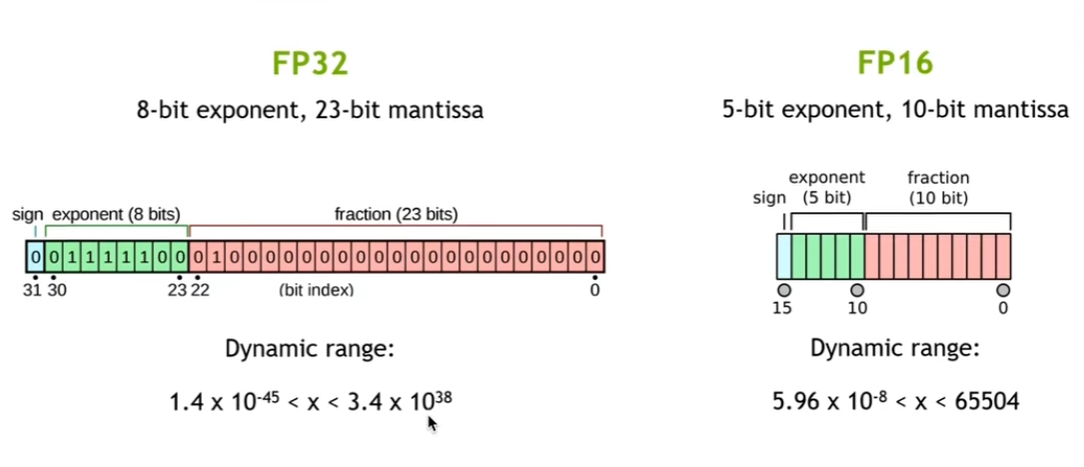
- fp32(single precision)vsfp16(half precision)
- fp16的dynamic range是足够的,gradient(weight update)的计算将其scale避免fp16的浮点数下溢
- fp16 is fast and memory-efficient:
- 更快的compute throughout
- 更高的memory throughout
- 更小的显存占用
para = torch.cuda.HalfTensor([1.])
update = torch.cuda.HalfTensor([.0001])
para + update
para = torch.cuda.FloatTensor([1.])
update = torch.cuda.FloatTensor([.0001])
para + updateamp
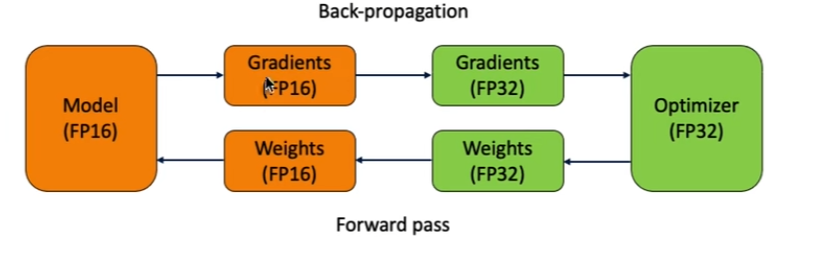
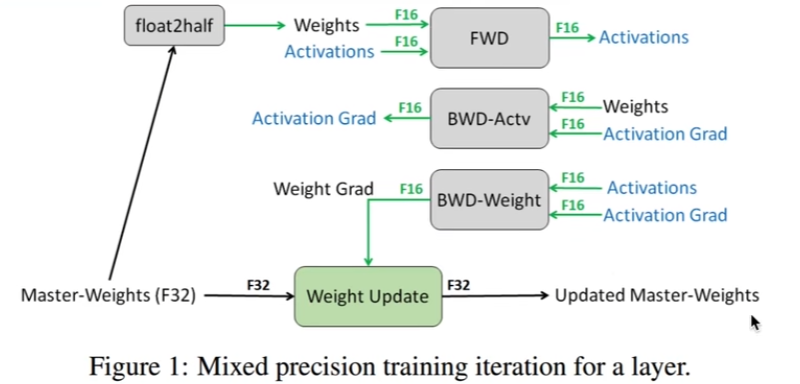
- forward:weights,activations
- backward:activation grad,weighth grad
- update(weight gradients 乘上学习率)会非常小,在FP16中,小于2^(-24)的数都会被置0
- 2-level NN
torch.cuda.HalfTensor([2**-24])loss scaling
scaler = GradScaler()

# forward
with autocast():
	output = model(input)
	loss = loss_fn(ouput,target)
#backward
scaler.scale(loss).backward()
scaler.step(optimizer)
scaler.update()- 针对的是loss(loss scaling)
- small gradients may underflow in FP16 regions of the network
- scaling the loss brings gradients into the fp16 dynamic range
- unscale gradients in PF32 for
optimizer.step()