
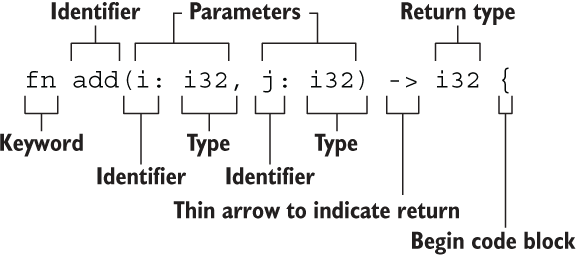
Rust的函数,和其他语言几乎没有什么差异。
fn add(i:i32,j:i32)->i32{
	i+j
}
函数名和变量名可采用蛇形命名法,fn add_two()->{}
函数参数
rust是静态类型语言,因此需要为每一个函数参数标识出它的具体类型
fn main(){
	another_function(5,6.1);
}
fn another_function(x:i32,y:i32){
	println!("The value of x is:{}",x);
	println!("The value of y is:{}",y);
}another_function函数有2个参数,其中x是i32类型,y是f32类型,这里去掉x或者y中任意一个的类型都会报错
fn main(){
	another_function(5,6.1);
}
fn another_function(x:i32,y){
	println!("The value of x is {}",x);
	println!("The value of y is {}",y);
}
函数返回
函数的返回值就是函数体最后一条表达式的返回值,当然也可以用return提前返回
fn plus_five(x:i32)->i32{
	x+5
}
fn main(){
	let x = plus_five(5);//侧面说明了函数也是表达式

	println!("The value of x is {}“,x);
}
fn plus_or_minus(x:i32)->i32{
if x>5{
return x-5
}
x+5
}
fn main(){
let x = plus_or_minus(5);
println!("The value of x is {}",x);
}Rust中的特殊返回类型
无返回值()
对于单元类型(),是一个0长度的元组。虽然没啥用,但是可以用来表达一个函数没有返回值:
- 函数没有返回值,返回
() ;结尾的语句返回()
use std::fmt::Debug;
fn report<T:Debug>(item:T){
	println!("{:?}",item);
}report会隐式的返回一个()
fn clear(text:&mut String)->(){
	*text = String::from("");
}在实际编程中,会经常看见错误提示中看到()的身影,假如函数需要一个u32值,但是不幸的以表达式;的语句形式作为函数的最后一行代码,就会报错
fn add(x:u32,y:u32)->u32{
	x+y;
}
|
1 | fn add(x:i32, y:i32) -> i32 {
| --- ^^^ expected `i32`, found `()`
| |
| implicitly returns `()` as its body has no tail or `return` expression
2 | x + y;
| - help: remove this semicolon to return this value永不返回的发散函数!
当用!作函数返回类型的时候,表示该函数永不返回。特别的,这种语法往往会导致程序崩溃的函数:
fn dead_end()->!{
	panic!("你已经到了穷途末路,崩溃吧!"`);
}
无限循环:
fn forever()->!{
	loop{
	//...
	};
}